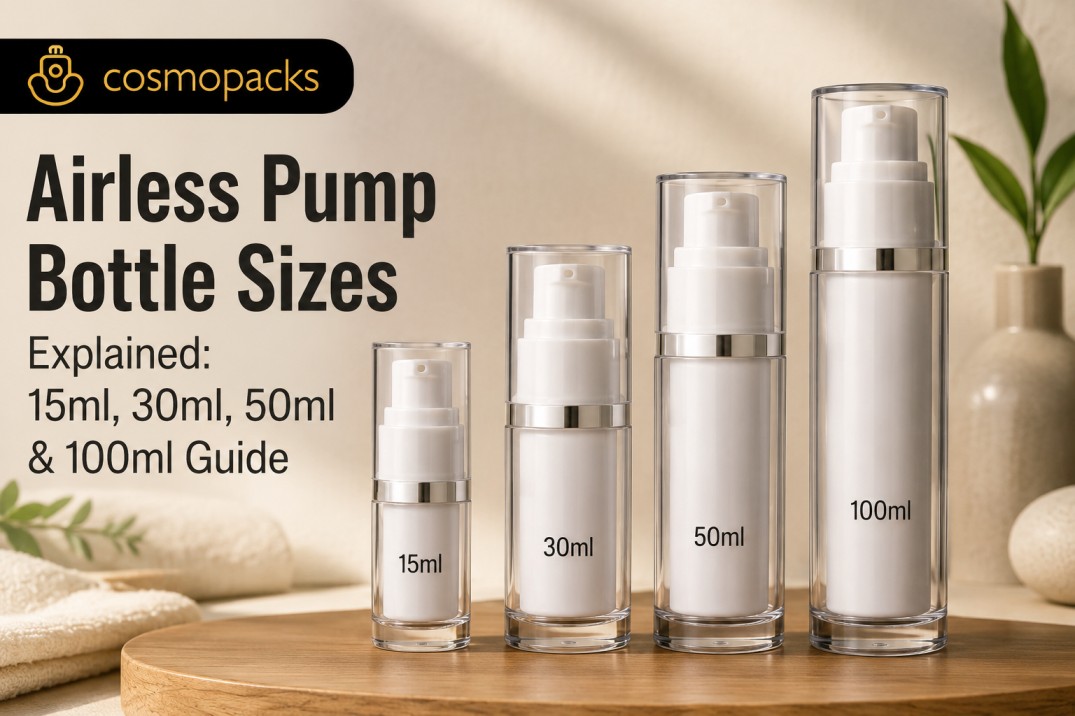
Pick the wrong bottle size and you’ll know it fast. Customers complain the product ran out in two weeks, or they never finish the bottle and move on before reordering. Airless pump bottles come in four standard sizes: 15 ml, 30 ml, 50 ml, and 100 ml, and each one exists for a reason. This guide walks through what those reasons actually are, so your next wholesale order matches your formulation, your customer, and your brand’s positioning from the start.
What Is an Airless Pump Bottle?
Most pump bottles work with a dip tube. Press the top, and the tube draws product up from the bottom while air fills the space left behind. Over time, that air exposure breaks down sensitive ingredients; vitamin C oxidizes, retinol degrades, and antioxidants lose potency before the customer even gets through half the bottle.
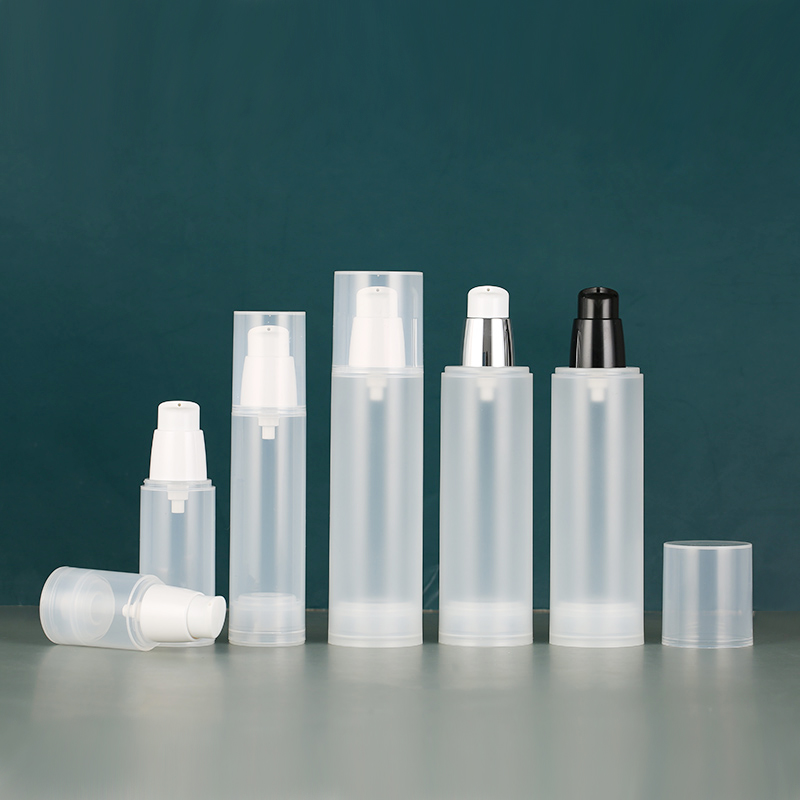
An airless pump bottle works differently. There is no dip tube. Instead, a spring-mounted disc sits at the base of the bottle. Every time you press the pump, that disc rises slightly, pushing product upward. No air enters. The formulation stays sealed from first use to last.
The practical result: a well-made airless pump bottle recovers close to 98% of its contents. For a brand selling a $120 serum in a 30ml bottle, that is not a minor detail; it is the difference between a customer who feels they got their money’s worth and one who is frustrated that a third of the bottle seemed to disappear.
At Cosmopacks, we have been manufacturing cosmetic packaging for over a decade, working with more than 100 skincare and beauty brands worldwide. The sizing question comes up in nearly every first conversation with a new client. Here is how we think through it.
How to Use an Airless Pump Bottle
Before getting into sizes, this is worth knowing, because it also affects how you explain the product to your customers.
Press straight down on the pump head. That is it. Unlike a conventional pump where you might tip the bottle or shake it when the product seems low, an airless bottle dispenses cleanly until the disc reaches the top. When dispensing feels sluggish near the end, the bottle is nearly empty, not broken. Customers who understand this stop sending returns and start placing reorders.
If your packaging includes an insert card or you have a product FAQ on your site, two sentences explaining this saves a lot of customer service time.
15ml Airless Pump Bottles: The Precision Size
How Big Is 15ml?
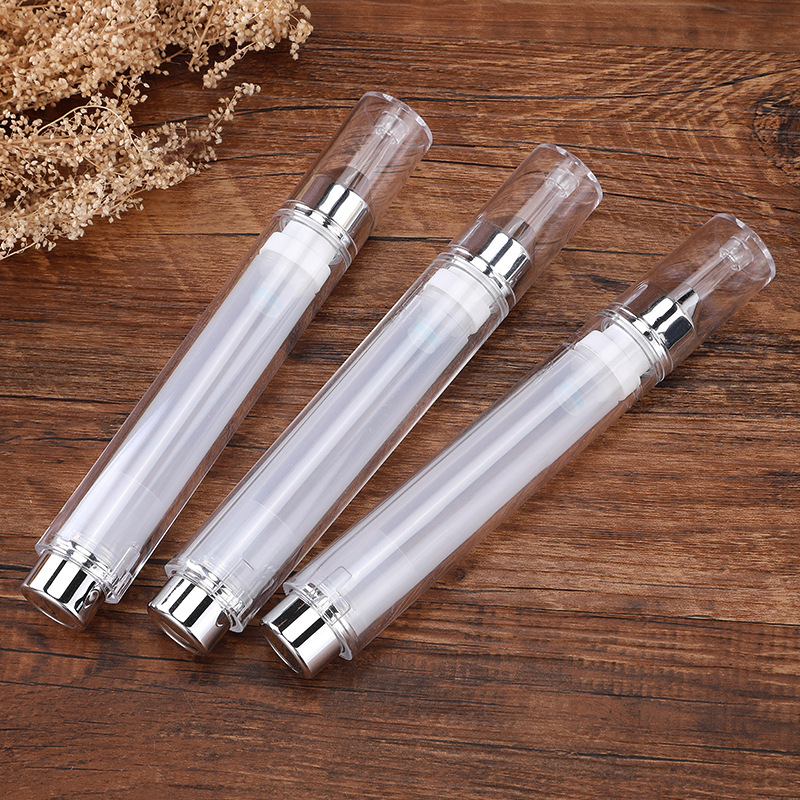
Hold your thumb up. A 15ml airless pump bottle is roughly that height, compact, lightweight, and fits in a jacket pocket or a small clutch without effort. It holds about half a fluid ounce of product.
What Goes in a 15ml Bottle?
The short answer: anything applied in very small amounts to a specific area.
The 15ml Serum Syringe Cosmetic Airless Bottle at Cosmopacks was designed specifically for eye creams and targeted serums. It is made from PETG and PP, comes with a metal applicator tip for massaging the under-eye area, and is available in 10 ml, 15 ml, and 20 ml capacities. The construction handles organic formulations, retinol serums, peptide concentrates, and vitamin C treatments, where even minor air exposure causes visible degradation over weeks.
Beyond eye care, 15ml white airless pump bottles are the standard for:
- Trial and sample kits, small enough to include as a gift-with-purchase, priced accessibly enough that new customers can try before committing to a full-size bottle
- High-concentration treatments, ampoules, growth factor serums, professional-grade formulations where a little goes a long way
- Travel sets, four 15ml bottles fit neatly into a single travel pouch, and the airless seal means nothing leaks in a bag
One thing brands sometimes overlook: a 15ml airless pump bottle does not feel cheap. In acrylic or PETG with a quality surface finish, it can look and feel like a luxury product. The size itself signals exclusivity when paired with the right formulation and presentation.
30ml Airless Pump Bottles: The Serum Standard
How Big Is 30ml in a Bottle?
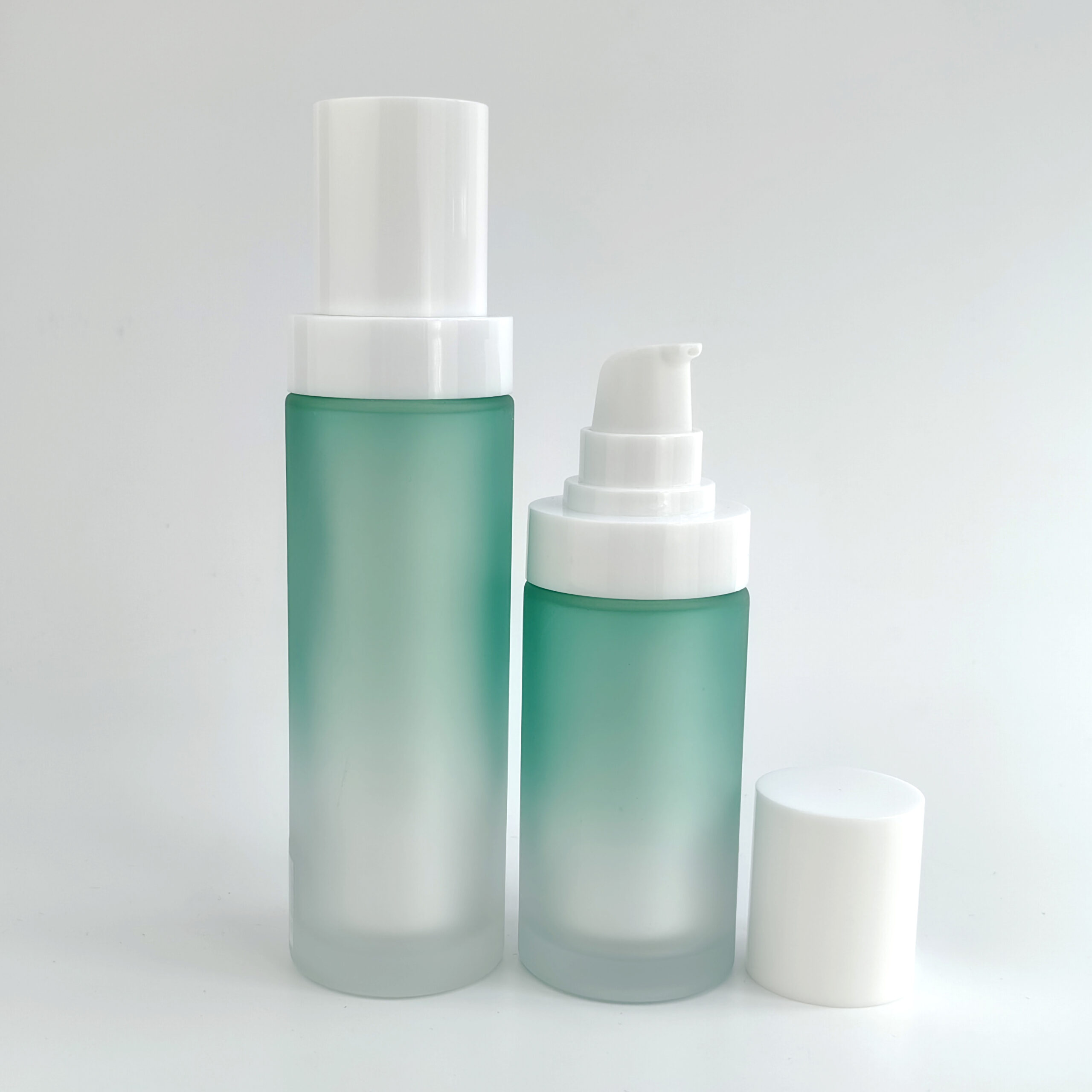
One fluid ounce. That is the 30ml airless pump bottle in practical terms. It stands roughly 10 to 13 centimeters tall, fits in one hand, and is the format that skincare buyers at department stores, specialty retailers, and direct-to-consumer brands recognize as “full-size serum.”
Walk through any prestige skincare counter and you will see this size everywhere, not because the industry settled on it arbitrarily, but because it works. For a customer applying one to two pumps of serum twice a day, 30ml lasts between 30 and 60 days. That is a monthly or bi-monthly replenishment cycle, which is exactly what subscription-based and DTC brands want.
Why 30ml Is the Most Requested Size for Wholesale Orders
At Cosmopacks, the 30ml airless pump bottle is the highest-volume SKU in our airless category. Part of that is familiarity, it is what buyers expect. Part of it is practicality.
Consider the glass option. Cosmopacks produces a 30ml glass airless pump bottle with an eco-friendly glass outer and a refillable PCR inner bottle. Premium and clean beauty brands use this configuration to minimize plastic in their supply chain while keeping the protective vacuum seal that their active formulations require. The inner bottle is replaceable, which appeals to sustainability-focused customers who want to reduce packaging waste over time.
The 30ml white airless pump bottle in PP, polypropylene, covers a completely different market segment. Lightweight, cost-effective, recyclable, and compatible with almost every cosmetic formulation, it is the go-to for brands that want professional packaging without the premium material cost. For 30ml airless pump bottle wholesale orders, PP is the most commonly specified material, particularly for brands launching their first product line.
Acrylic (PMMA) sits between those two options. It has a glass-like optical clarity that elevates brand perception noticeably on a retail shelf or in an unboxing video, without the fragility or shipping weight of actual glass. For a 30ml bottle that needs to look expensive, acrylic is the material conversation worth having.
50ml Airless Pump Bottles: Room to Breathe
What Is the Typical Size of a 50ml Bottle?
A 50ml airless pump bottle holds 1.7 fluid ounces. In the hand, it feels substantial, around 13 to 15 centimeters tall with a diameter of 4 to 5 centimeters depending on the shape. For context, it is roughly the size of a small travel-sized deodorant stick. Large enough to feel like a real product, compact enough to sit on a bathroom shelf without overwhelming it.
For a customer using one to two pumps morning and night, 50ml typically represents 60 to 90 days of use. That quarterly cycle suits brands building a subscription model where the customer gets a new bottle every three months.
Which Formulations Belong in a 50ml Bottle?
This is where moisturizers, liquid foundations, BB creams, and SPF products live. These formulations are applied more generously than a serum, two or three pumps across the full face, possibly extending to the neck and décolletage. A 30ml bottle would empty too quickly; a 100ml bottle would feel excessive for a product used in moderate amounts.
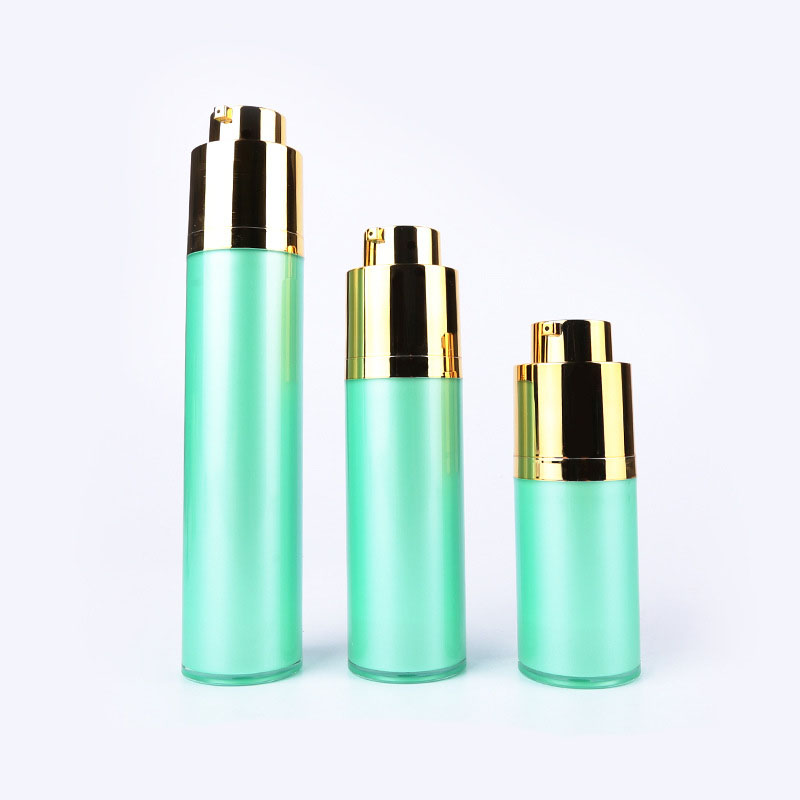
The 50ml Green Acrylic Airless Pump Bottle at Cosmopacks is made from PMMA, PP, and ABS. The crystal-clear acrylic body shows the product color through the bottle; for a tinted moisturizer, a pigmented foundation, or a green-colored formula, this transparency becomes a selling point rather than a neutral feature. The rotary switch pump locks during transit, which makes it a practical 50ml airless pump travel bottle for markets where products are bought online and shipped internationally.
Beyond travel, 50ml is the right size for:
- Facial moisturizers and day creams that cover the full face and neck
- Liquid foundations where the customer dispenses several pumps per application
- Sunscreen formulations that need to be applied generously to be effective
- Treatment moisturizers that combine actives with a hydrating base, something between a serum and a cream
100ml Airless Pump Bottles: The Hero Product Size
What Is the Size of a 100ml Bottle?
3.4 fluid ounces. That is the figure that frequent travelers recognize immediately, it is the maximum liquid volume allowed in TSA carry-on bags. A 100ml airless pump bottle stands roughly 15 to 18 centimeters tall, with a diameter of 5 to 6 centimeters. It has real weight in the hand. On a bathroom shelf, it looks like an investment.
For a customer using one to two pumps per day, 100ml can represent three to six months of supply depending on the formulation. That is a different purchasing psychology than a 30ml serum. The customer is not making a monthly decision, they are committing. That commitment needs to feel justified by the product experience and the packaging quality.
When the 100ml Size Makes Sense for Your Brand
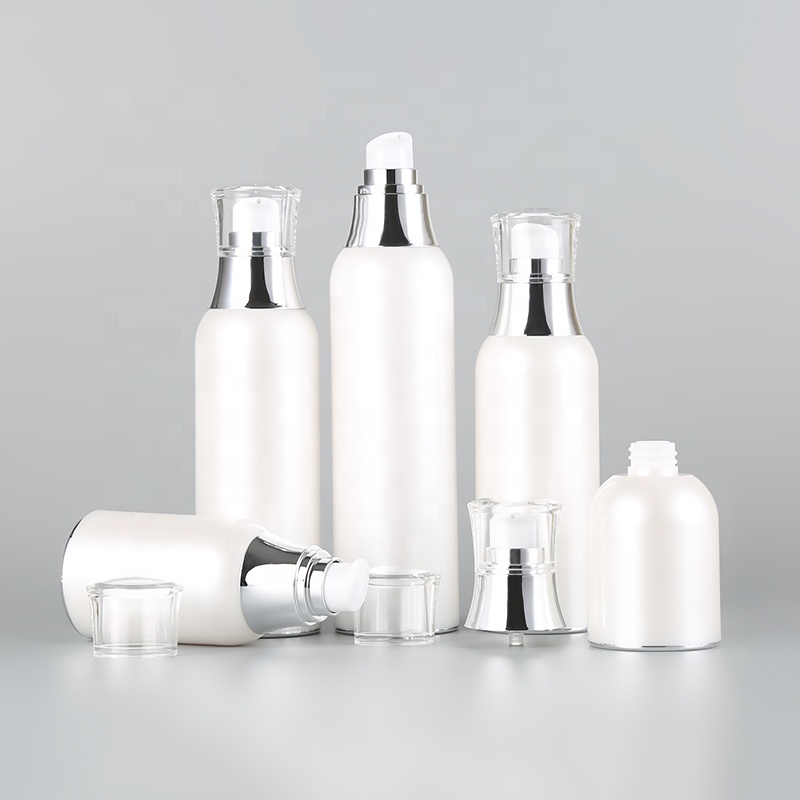
The 100ml airless pump bottle in acrylic is among the more frequently requested configurations for private label orders at Cosmopacks. The 3oz format is associated with full-size, premium products in the American skincare market, the bottle that sits on the vanity rather than traveling in a bag.
The 100ml format in PP serves a different purpose: high-volume wholesale, professional-use products, and brands where cost efficiency at scale is the priority. PP at 100ml is significantly lighter than acrylic, which reduces shipping costs across large orders, a consideration that matters when you are moving thousands of units.
The 100ml white airless pump bottle is the standard size for:
- Body serums and face-to-body crossover formulations where application covers a larger surface area
- Anti-aging creams positioned as a brand’s flagship product
- Clinical and professional-use products dispensed in larger quantities per treatment
- Subscription bundles where the brand wants to offer the best per-milliliter value to loyal customers
One practical note on the 100ml and the airless mechanism: as the disc rises toward the top of the bottle near the end of its life, some customers assume the pump is failing. Including a short note in your packaging, “When dispensing slows, the disc has nearly reached the top. Your bottle is almost empty, not broken”, prevents unnecessary returns.
Airless Pump Bottle Materials: A Quick Reference
The size is only part of the decision. The material changes the look, the weight, the feel, and the cost per unit.
PP (Polypropylene), Lightweight, recyclable, cost-effective, compatible with nearly all cosmetic formulations. The practical choice for mid-market brands and high-volume wholesale orders.
Acrylic (PMMA), Glass-like clarity, premium appearance, heavier in hand. Preferred by brands in the prestige skincare segment where shelf presence and unboxing experience matter.
PETG, Used in precision formats like the 15ml eye serum syringe. Good chemical compatibility and clarity, suitable for sensitive formulations.
Glass, The cleanest sustainability story, available in the 30ml configuration with a refillable inner bottle. Adds weight and shipping cost but suits brands that have made plastic reduction a public commitment.
ABS, Durable with excellent surface adhesion for printing and decoration. Often used in combination with PP or acrylic for structural components.
All materials at Cosmopacks are available with surface finishing options: silk-screen printing, hot stamping in gold or silver foil, UV coating, frosted “Ice Matte” finish, and custom Pantone colors. The manufacturing facility in Shangyu City, Zhejiang Province covers 12,000 square meters with more than 30 injection molding machines and a 98% quality rate across 20 million packaging sets produced annually.
Four Questions to Ask Before Placing Your Wholesale Order
Working through these before you contact a supplier saves time and avoids expensive size mismatches:
1. How many pumps does your customer use per application? Count it out. One pump for eye cream. Two to three for a face serum. Four to five for a moisturizer. Multiply by twice daily for 30 days. That tells you how quickly the bottle empties.
2. What replenishment cycle do you want? Monthly reorders = 15ml or 30ml. Quarterly = 50 ml. Biannual or “hero product” = 100 ml.
3. How thick is your formula? Very thin serums and oils dispense easily in small airless formats. Thicker creams and gel creams may need a pump head with a wider aperture, something to confirm with your packaging supplier before sampling.
4. Will customers travel with this product? 15 ml and 50 ml both clear TSA carry-on rules at 3.4 oz or under. If travel is a genuine use case for your customer, those are the two sizes to build around. Cosmopacks produces several configurations specifically designed as airless pump travel bottles with locking pump mechanisms.
Frequently Asked Questions
- What are standard airless pump bottle sizes?
The four standard sizes are 15 ml, 30 ml, 50 ml, and 100ml. Each corresponds to a different product category and customer usage pattern: 15 ml for serums and eye creams, 30 ml for daily serums, 50 ml for moisturizers and foundations, and 100 ml for larger creams and professional products. - How do I know which airless pump bottle size is right for my formula?
Start with how much your customer will use per application and how often. Then decide your target replenishment cycle. A formulation used in tiny amounts twice daily belongs in a 15ml or 30ml bottle. A moisturizer applied generously once or twice a day belongs in 50 ml. A product used in large quantities or positioned as a long-term investment belongs in 100 ml. - Are airless pump bottles refillable?
Many are. Cosmopacks produces refillable airless pump bottles at multiple sizes, including a 30ml glass airless format with a replaceable inner PCR bottle. Refillable packaging reduces single-use plastic across the product’s lifetime and is increasingly requested by both brands and consumers. - What materials are airless pump bottles made from?
PP, acrylic (PMMA), PETG, ABS, glass, and combinations of these. Material choice affects weight, clarity, cost, and sustainability profile. Cosmopacks offers all of these with full customization, color, finish, and decoration. - What is the minimum order quantity for airless pump bottles wholesale?
MOQ varies by specification. For standard off-the-shelf airless pump bottle styles at Cosmopacks, MOQ starts at 5,000 pieces per SKU for most configurations. Custom colors, finishes, and OEM designs may require higher quantities. Contact the Cosmopacks team directly for a wholesale quote.
Key Takeaways
- 15 ml: Eye creams, concentrated serums, travel samples. Applied in drops, used in targeted areas, and priced as a luxury item despite the small volume.
- 30 ml: The universal serum size. Recognized globally, it drives monthly replenishment and is available in PP, acrylic, and glass.
- 50 ml: Moisturizers, foundations, and SPF. Covers more surface area, suits a quarterly purchase cycle, and is available in configurations designed for international shipping.
- 100 ml: The flagship size. Signals premium positioning, works for professional or high-volume applications, and requires the customer to commit to the product.
- Airless technology protects formulations and recovers nearly all of the product; that is the actual value proposition, and it applies to every size.
To explore the full range of airless pump bottle packaging or request a wholesale quote, visit cosmopacks.com or read more packaging guides on the Cosmopacks blog. For service and customization options, see full-service packaging solutions.
About the Author
George Lu is the founder and lead contact at Cosmopacks, a B2B cosmetic packaging manufacturer and wholesale supplier. Cosmopacks is located at 46 Country Wood Drive, Pomona, CA 91766, with manufacturing operations in Shangyu City, Zhejiang Province. The company has served more than 100 cosmetic and skincare brands worldwide over more than ten years. George can be reached at george@cosmopacks.com or +1 626 203 5398. For a showroom tour or to speak with the team directly, visit the contact page.