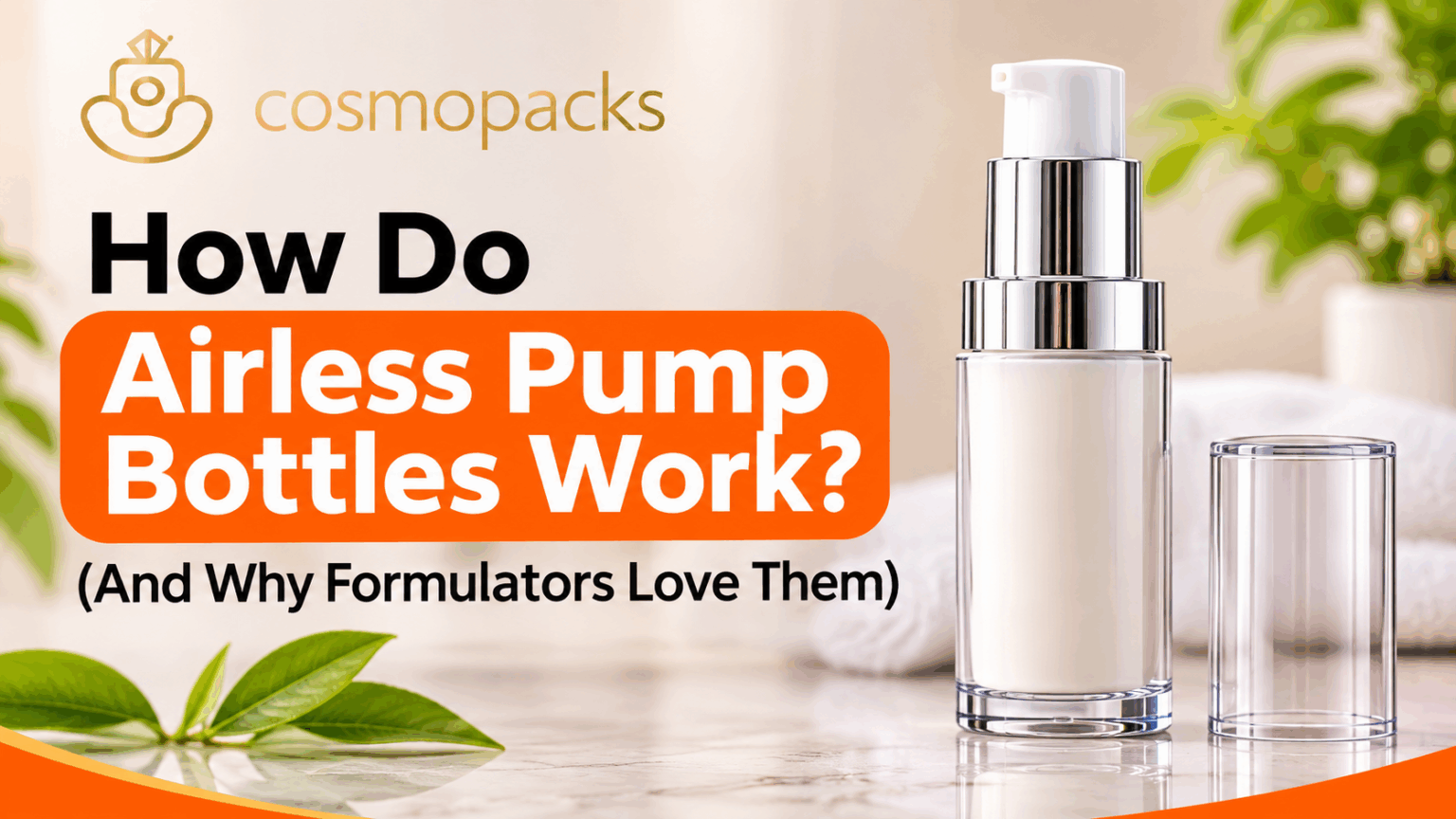
Airless pump bottles work by using a vacuum-driven piston system instead of a dip tube. When you press the pump head, air pressure inside the bottle drops, pushing a rising disc (the piston) upward and forcing the product out through the nozzle, without letting any outside air in. This keeps skincare formulas, especially oxidation-sensitive serums, retinol treatments, and vitamin C products, fresher and more effective for longer. Cosmopacks has been manufacturing and supplying these bottles to cosmetic brands worldwide for over ten years, and the technology behind them is simpler than most people expect.
What Is an Airless Pump Bottle, and How Is It Different from a Regular Pump?
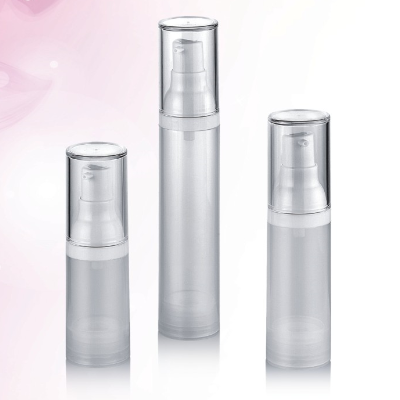
Most skincare bottles you have used work with a dip tube, a thin plastic straw that runs from the pump head all the way to the bottom of the bottle. Every time you press the pump, a small amount of air enters the bottle to replace the product that just left. That air exchange is exactly what causes active ingredients to degrade over time.
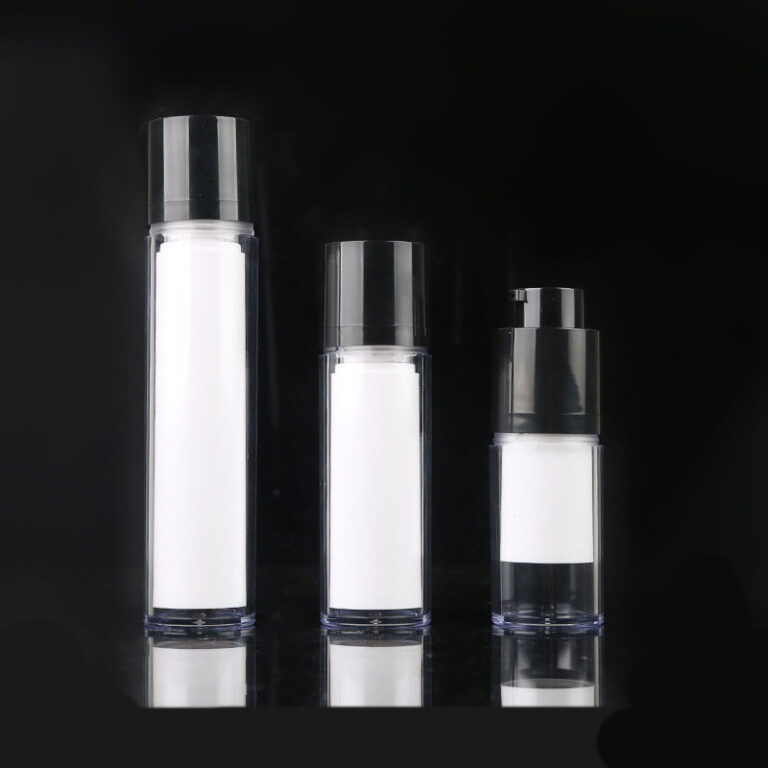
An airless pump bottle removes the dip tube entirely. Instead, the bottle contains a tightly fitting disc or piston that sits beneath the product. As you dispense product through the pump, the piston rises from the bottom, maintaining constant pressure on the formula and keeping the headspace above the product air-free.
This is not a small difference. For formulas containing retinol, vitamin C, hyaluronic acid, or plant-based actives, air exposure is the primary cause of degradation. Switching to airless pump bottles can extend a product’s effective shelf life meaningfully, without increasing preservative load.
Key point: A regular pump lets air in; an airless pump keeps it out. That single difference changes how long a skincare product stays effective.
How Do Airless Pump Bottles Work? (The Mechanics, Step by Step)
The mechanism inside an airless pump bottle has four main components working together:
● The pump head, the part you press down on.
● The nozzle and actuator, which directs the product out of the bottle.
● The pump chamber, a small cylinder that fills with product as the piston rises.
● The piston (or rising disc), a tight-fitting platform that moves upward as product is dispensed.
Step 1: Press the Pump Head
When you press down on the pump head, it compresses the spring inside the pump chamber. This creates a brief surge of pressure that pushes a measured dose of product up through the nozzle and out of the bottle.
Step 2: The Spring Recoils
As the pump head releases, the spring inside the chamber recoils to its original position. This recoil creates a small vacuum within the chamber, a negative pressure zone.
Step 3: The Piston Rises
The vacuum created in the chamber draws product downward from the bottle into the pump chamber. Because the piston is fitted tightly against the bottle walls, it moves upward incrementally to follow the product, maintaining contact and keeping the space above it free of air.
Step 4: The Cycle Repeats
Each time you press the pump, the piston climbs a fraction higher. By the time the bottle is almost empty, the piston has risen nearly to the top, which is why airless pump bottles can dispense up to 95% of their contents. Regular pump bottles often leave 15–20% of product stuck at the bottom.
Key point: The piston does the real work. It is what separates an airless bottle from every other cosmetic packaging format.
Why Do Skincare Formulators and Beauty Brands Prefer Airless Pump Bottles?
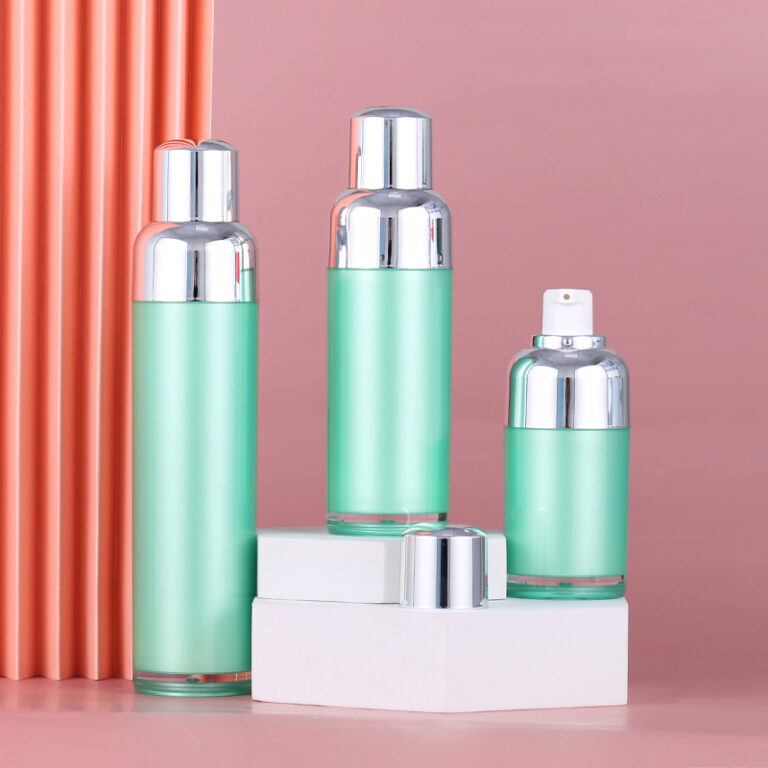
Formulators, the chemists and product developers who create skincare formulas, have practical reasons for preferring airless packaging over standard pump or jar formats. The packaging choice directly affects what goes into the formula and how much of it stays active through the product’s entire life cycle.
1. They Can Use Fewer Preservatives
When a formula is never exposed to air during use, the risk of contamination and oxidation drops significantly. This gives formulators room to reduce the amount of preservatives in a formula, a selling point for clean beauty brands and consumers who read ingredient lists carefully.
2. Active Ingredients Stay Active
Vitamin C, retinoids, peptides, and antioxidants are notoriously unstable when exposed to air. Conventional packaging degrades these ingredients every time the lid is opened or the bottle is used. Airless packaging protects the formula between uses, so the product a customer uses on day 60 is roughly as effective as the product on day one.
3. Precise Dosage Every Time
The pump mechanism in a well-made airless bottle delivers a consistent dose with every press. Cosmopacks’s airless bottles offer controlled dosage outputs of 0.20cc, 0.5cc, and 1ml, which matters for high-concentration serums where over-application can cause irritation and under-application reduces results.
4. No Cross-Contamination
Jars and open bottles invite the user’s fingers into the product, introducing bacteria and skin cells with every use. Airless pump bottles are a closed system, the formula is never touched directly, which is especially important for medical-grade creams, wound care formulations, and anything marketed as microbiome-friendly.
Key point: Formulators love airless packaging because it protects their work, letting the formula perform the way it was designed to, from the first use to the last.
What Types of Airless Pump Bottles Are Available for Cosmetic Brands?
Cosmopacks manufactures a full range of airless cosmetic packaging, designed to suit different product types, brand aesthetics, and sustainability goals. Here is an overview of the main options:
By Material
● PP (Polypropylene), Lightweight, recyclable, and chemically resistant. Available in natural white, frosted soft-touch, and matte black finishes.
● Acrylic, High-gloss, premium-looking. Often used in luxury skincare lines. Available in shiny silver and gold finishes.
● PETG, Clear and durable, allows consumers to see the product inside. Available in styles such as the PETG Rose Gold 30ml Plastic Airless Spray Pump Bottle.
● Glass, For brands that prefer non-plastic packaging. Glass airless pump bottles offer a premium look with strong inert properties.
● PCR (Post-Consumer Resin), Made from recycled plastic, reducing CO2 emissions and supporting circular packaging systems.
● Bamboo, A renewable, biodegradable material for eco-conscious product lines.
By Size
Cosmopacks supplies airless bottles in sizes ranging from 5ml travel formats up to 250ml large-capacity containers. Common sizes include 10ml, 15ml, 30ml, 50ml, 100ml, 120ml, 150ml, and 200ml. This range covers everything from eye serums and spot treatments to full-size moisturizers and body lotions. Full product options are available at cosmopacks.com/airless-bottles.
By Shape
● Round, The most common format, available in both straight-sided and tapered styles.
● Square, A clean, modern profile that photographs well and stacks efficiently in retail environments.
● Syringe shape, A clinical, precise format, well-suited for serums and eye treatments. See the PP Airless Bottle Syringe Shape 10ml Cosmetic Packaging in the Cosmopacks product range.
● Refillable designs, Including the Refillable 15ml Acrylic Lotion Pump Airless Bottle, designed for brands committed to reducing single-use packaging waste.
By Finish
Surface finishing options include UV lacquering, metallic coatings in matte or gloss, hot stamping in gold or silver, and Cosmopacks’s proprietary “Ice Matte” frosted finish. These options let a brand’s packaging communicate its positioning, clinical and minimal, or luxurious and editorial, without changing the underlying bottle structure.
Can You Refill or Reuse an Airless Pump Bottle?
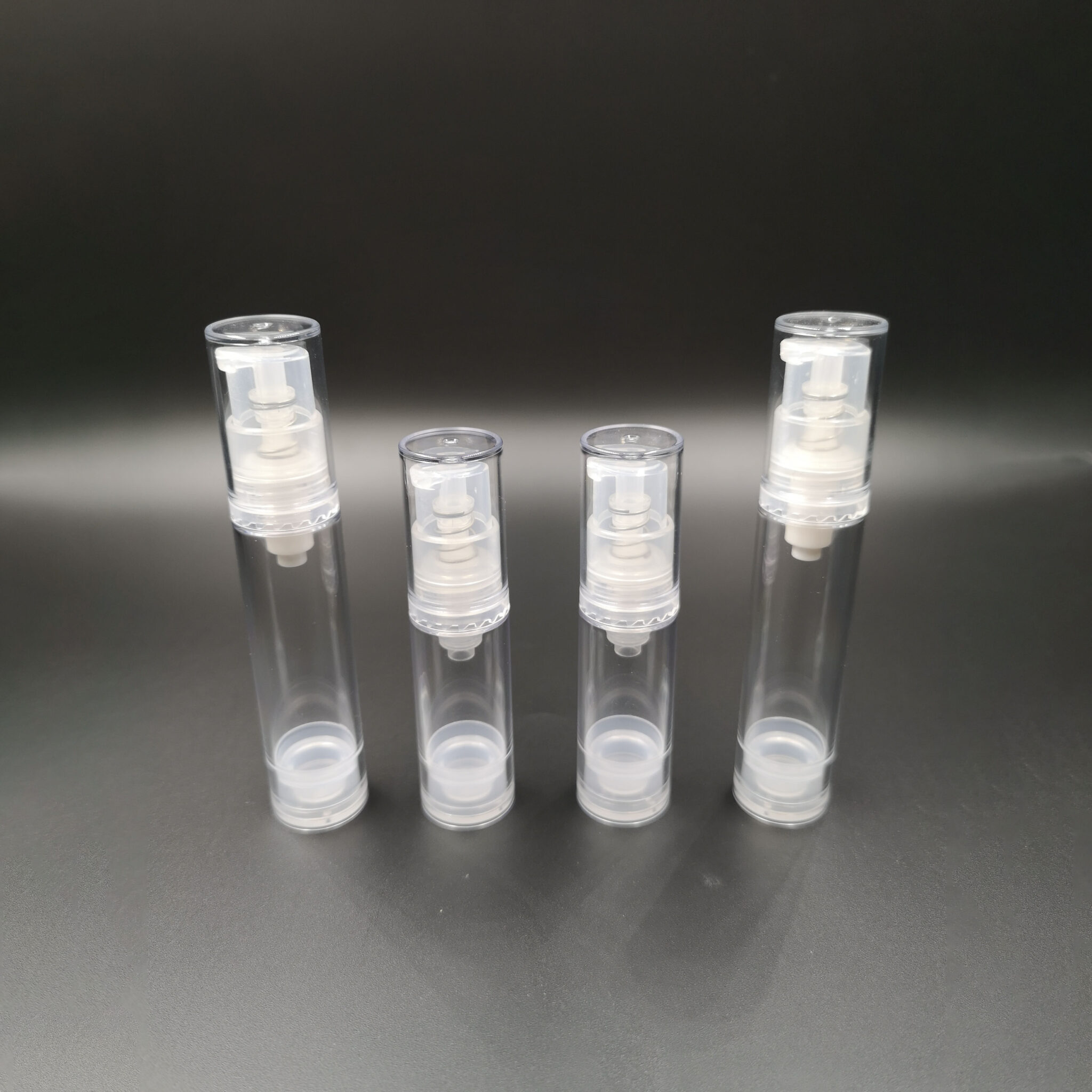
Yes, with the right bottle design. Some airless pump bottles have a removable base or a detachable pump head that makes refilling straightforward. Others are designed as single-use formats and are more difficult to refill without contaminating the formula inside.
The most important factor is sanitation. If you refill an airless pump bottle, the interior must be thoroughly cleaned and dried before adding new product. Any residue from the previous formula can react with the new formula, reduce its shelf life, or introduce microbial contamination. Cosmopacks offers dedicated refillable airless bottle formats, such as the Refillable 15ml Acrylic Lotion Pump Airless Bottle, for brands that want to offer a refill program as part of their sustainability strategy.
From a brand perspective, refillable airless packaging is growing in relevance. Consumers in North America, Europe, and Australia are increasingly choosing brands that offer a low-waste refill option. Building refillability into the packaging from the design stage is far more cost-effective than trying to retrofit it later.
What Happens When an Airless Pump Bottle Stops Working?
The most common reason an airless pump bottle stops dispensing is that the piston has reached the top of the bottle and there is no more product to push upward. This is a sign the bottle is empty, not broken.
Other causes of pump failure include:
● Air lock, a small air bubble trapped beneath the piston prevents it from rising. Solution: turn the bottle upside down and press the pump several times to redistribute the product and release the air.
● Pump head not fully primed, new bottles sometimes require 5–10 pump presses before product begins to flow. This is normal.
● Clogged nozzle, thick formulas like dense creams can dry in the nozzle if the bottle has not been used for a while. Clean the nozzle tip with a damp cloth and try again.
● Spring fatigue, in lower-quality bottles, the internal spring can weaken over time and lose its ability to create suction. This is rare in well-manufactured airless bottles but more common in very inexpensive formats.
If the bottle is from Cosmopacks, each unit passes a pressure resistance test, deform resistance test, and leakage resistance test before dispatch. The QC checklist includes functional testing at the assembly stage, spot checks during production, and a final appearance inspection, so pump failure before the bottle is empty should not occur with properly manufactured stock.
How to Use an Airless Pump Bottle Correctly
Using an airless pump bottle correctly extends the product’s life and ensures you get every drop out of it.
● Prime before first use, press the pump head repeatedly until product appears. For most bottles this takes 3–8 presses.
● Keep the bottle upright during use, most airless pump systems are designed to work vertically, with the pump at the top.
● Do not force the pump, if resistance increases, the bottle may be nearly empty. Pressing harder does not help and can damage the piston mechanism.
● Store at room temperature, away from direct sunlight, UV exposure can degrade both the formula and the packaging material, particularly clear PETG or acrylic formats.
● Replace the cap after each use, even though the formula is protected internally, the nozzle tip is exposed when uncapped and can accumulate dust or dry product.
Why Cosmopacks Manufactures Airless Pump Bottles the Way It Does
Cosmopacks is based in Shangyu City, Zhejiang Province, China, one hour from the nearest port, with a US contact office in Pomona, California. The manufacturing facility covers 12,000 square metres, operates 30+ injection moulding machines, and produces over 20 million packaging sets annually with a quality rate of 98%.
The production process follows six sequential stages: raw material preparation, injection moulding, surface treatment, printing, assembly, and inspection. Each stage has its own quality checkpoint. The raw material sourcing prioritises recyclable polymers, PP, PETG, PCR, and PLA, alongside glass and bamboo for brand clients who have made specific sustainability commitments.
Surface treatment at the Cosmopacks facility uses vacuum coating and UV coating to achieve finishes that hold up through shipping, retail display, and daily use. The printing line uses hot stamping and automatic screen printing to apply logos, brand names, and artwork directly to the bottle surface, no labels required, which reduces packaging waste and improves recyclability.
For brands that want to customise their airless pump bottles wholesale, Cosmopacks offers full OEM and ODM services, covering size, shape, capacity, colour, material, and finish. Minimum order quantities start at 5,000 units, with flexibility for new brands and start-ups just entering the market.
Key point: Cosmopacks supplies over 100 cosmetic brands globally. The company’s combination of lean manufacturing, flexible MOQs, and sustainable material options makes it a practical choice for brands at every stage of growth.
Key Takeaways
● Airless pump bottles work by using a rising piston, not a dip tube, to push product out without letting air in.
● The vacuum-driven mechanism protects oxidation-sensitive ingredients like vitamin C, retinol, and peptides throughout the product’s life cycle.
● Each press delivers a consistent, measured dose, typically 0.20cc, 0.5cc, or 1ml, reducing waste and improving the user experience.
● Airless bottles can dispense up to 95% of their contents, compared with as little as 80% for traditional pump formats.
● Material options include PP, PETG, acrylic, glass, PCR, and bamboo, covering both performance and sustainability requirements.
● Common pump issues (air lock, priming delay, clogged nozzle) are almost always fixable without replacing the bottle.
● Refillable airless bottle formats exist for brands building a low-waste product line.
Frequently Asked Questions About Airless Pump Bottles
1. What is an airless pump bottle?
An airless pump bottle is a cosmetic packaging format that uses a vacuum-driven piston instead of a dip tube and air vent to dispense product. The piston rises from the bottom as product is used, keeping the formula completely sealed from outside air at all times.
2. How do airless pump bottles work differently from regular pumps?
Regular pump bottles let a small amount of air into the bottle each time the pump is pressed, to replace the product that has been dispensed. Airless pump bottles prevent this air exchange entirely, using an internal rising piston to maintain pressure on the formula without allowing air contact.
3. What sizes do airless pump bottles come in?
Airless pump bottles are available in a wide range of sizes, from 5ml travel formats to 250ml large-capacity containers. Common sizes for skincare products are 15ml, 30ml, 50ml, 100ml, and 150ml. See the full range at cosmopacks.com.
4. Can airless pump bottles be refilled?
Some airless pump bottles are designed to be refillable, with a removable base or detachable pump. When refilling, the bottle interior must be cleaned and fully dried first to prevent contamination. Cosmopacks offers dedicated refillable formats for brands building a reuse or refill program.
5. Why do beauty brands use airless pump bottles instead of jars?
Jars require the user to reach inside the product with their fingers, introducing bacteria and causing ongoing air exposure. Airless pump bottles eliminate both problems, the formula is never touched directly, and the pump system prevents air contact between uses. This makes airless bottles the preferred format for preservative-free, clean beauty, and high-active skincare formulations.
6. What materials are airless pump bottles made from?
Airless pump bottles are manufactured from a variety of materials depending on the brand’s needs. Cosmopacks produces airless bottles in PP, PETG, acrylic, glass, PCR (post-consumer resin), and bamboo, covering everything from lightweight everyday skincare packaging to premium, eco-certified formats.
7. What is the minimum order quantity for wholesale airless pump bottles?
Cosmopacks sets a standard minimum order quantity of 5,000 units for airless pump bottles wholesale, with flexibility for start-ups and new brands. Contact the team directly at george@cosmopacks.com or +1 626 203 5398 for a quote.
About the Author
George Lu is the founder and director of Cosmopacks, a cosmetic packaging manufacturer and wholesale supplier based in Zhejiang, China, with North American operations in Pomona, California. With over ten years of experience supplying packaging solutions to beauty brands across North America, Europe, and Australia, George works directly with skincare brands, indie beauty founders, and product formulators to match their formulas with the right packaging format. For enquiries, contact george@cosmopacks.com or call +1 626 203 5398.